Pale Blue Dot
A reflection on Voyager 1's Pale Blue Dot image, Carl Sagan's moral vision, and why that distant photograph still matters today.
There are few images in human history as small in scale and as vast in meaning as the Pale Blue Dot. On February 14, 1990, NASA’s Voyager 1 turned its camera back toward home and photographed Earth from about 3.7 billion miles away. In that image, our world appears as a tiny fleck of light suspended in a sunbeam.
Inside that almost invisible point is everything: every civilization, every war, every religion, every empire, every family, every private hope, every grief, every love story, every child just beginning to understand the world, every old person leaving it. The photograph is scientifically famous, but its deeper power is moral. It does not merely show us where Earth is. It shows us what Earth is: small, vulnerable, shared, and no one helped humanity understand that more clearly than Carl Sagan.
Voyager 1 launched on September 5, 1977, on a mission to explore the outer planets. It flew past Jupiter and Saturn, sent back historic images and data, and then kept going. In 2012, it crossed into interstellar space, becoming the first human-made object to do so. Voyager 1 is one of the great achievements of the space age. It is the farthest human-made object ever built: a machine from the 1970s still speaking across the dark, still carrying the stubborn signature of human curiosity. But Voyager 1 also gave us something rarer than engineering triumph. It gave us perspective.
Sagan was not just a commentator on the Pale Blue Dot; he helped make it happen. NASA says he was a member of the Voyager Imaging Team and had the original idea in 1981 to use one of the spacecraft’s cameras to image Earth from far away. He and others wanted humanity to see our planet as “a tiny, fragile speck in the cosmic ocean”. That instinct says almost everything about Sagan. He understood that the most important discoveries are not always about distant objects. Sometimes they are about ourselves. Sometimes science gives us not dominance, but proportion. Sometimes the greatest revelation is not what is out there, but how small and precious home really is.
When Voyager 1 finally took the photograph, it captured more than a planet. It captured a truth. Earth was not centered. It was not exalted. It was not marked out as the stage on which history had to unfold. It was simply there: one tiny inhabited world in a vast surrounding darkness.

The Pale Blue Dot endures because it strips away our illusions of scale. From the ground, our conflicts feel total. Nations seem absolute. Ideologies seem permanent. Leaders speak as though history bends around them. Yet from Voyager’s distance, none of our borders are visible. No armies. No walls. No campaign slogans. No claims of ownership. Just one world.
This is why the image still has force decades later. It is not merely beautiful. It is corrective. It rebukes arrogance. It interrupts narcissism. It asks whether the species clever enough to send a probe that far can also become wise enough to live together on the tiny world that launched it.
Carl Sagan’s genius was not only that he loved science. It was that he made science feel human. He did not present the cosmos as cold or emotionally distant. He presented it as a source of awe, responsibility, and tenderness. He insisted that skepticism and wonder belonged together. He believed that knowledge should enlarge our sympathy, not shrink it.
Long after the television clips, the book jackets, and the famous lines, what survives is his moral tone: lucid, humble, serious without pomposity, urgent without hysteria. He made it possible to think about galaxies and conscience in the same breath. He did not merely popularize astronomy. He dignified it. He made the study of the universe feel like an ethical education.
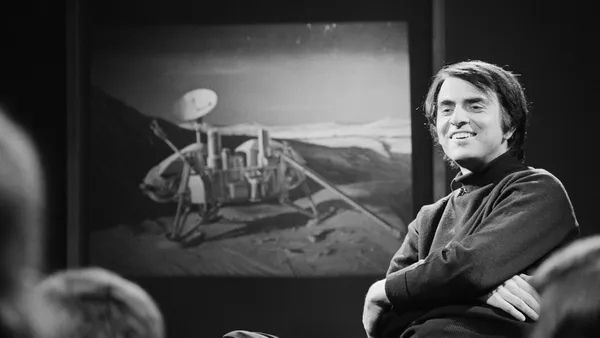
Voyager 1 carries instruments, radio systems, and the famous Golden Record, a message assembled as a kind of cultural time capsule from Earth. NASA still frames the mission not only as planetary exploration, but as part of humanity’s reach into interstellar space.
There is something deeply moving about that. Voyager 1 is a machine, but it is also a gesture: proof that a species capable of pettiness and brutality is also capable of building something that asks questions nobler than itself. We made war machines too. We made prisons and propaganda and systems of cruelty. But we also made Voyager.
The Pale Blue Dot is not naive. It does not ask us to pretend evil is unreal, or that war can be dissolved by sentiment. It asks something more demanding: that power be judged against scale, that leaders be judged against consequence, and that human beings remember how little room there really is for hatred on a planet this small.
Seen from billions of miles away, grievance politics looks smaller. So does national vanity. So does the language of domination. Every government, every movement, every cause that claims total moral centrality; all of them are operating on the same dust mote. None stands outside the shared vulnerability of this world. That does not erase responsibility. It sharpens it.
There is some irony here too. One of the most universal passages ever written about our shared fate on Earth still cannot be freely reproduced in full. The truth it expresses belongs to everyone; the exact wording, for now, does not. Perhaps that only proves how rare the language was. The vision became universal. The sentences did not.
Sagan’s point was never that human life is meaningless because we are small. It was that our smallness should make us gentler. If this pale blue dot is the only home we know, then cruelty is not only wicked. It is absurd. If every battlefield, every refugee camp, every ballot box, every courthouse, every school, every grave, and every cradle lies on this one faint point of light, then the moral task is not to win some final tribal argument. It is to become worthy of the world that carries us.
Voyager 1 is still moving outward. Carl Sagan is still speaking inward. One continues its silent journey through interstellar darkness. The other continues to remind us that knowledge without humility is dangerous, and power without perspective is childish. Together they left us one of the most haunting images ever made: not a portrait of Earth’s greatness, but of its preciousness.
In an age of war, spectacle, wounded nationalism, and loud men promising strength, the Pale Blue Dot offers a harder and better standard. It asks whether we can look at our world honestly: not as a stage for our vanities, but as a fragile home shared by everyone we love and everyone we will never meet.
At the end of all the rhetoric, all the campaigns, all the invasions, all the revenge, all the flags and speeches and claims of destiny, there is still only one small world, in a shaft of light, asking us to be better than we have been.
[…] Our posturings, our imagined self-importance, the delusion that we have some privileged position in the Universe, are challenged by this point of pale light. Our planet is a lonely speck in the great enveloping cosmic dark. In our obscurity, in all this vastness, there is no hint that help will come from elsewhere to save us from ourselves. […]
Unfortunately, I cannot reproduce the text in its entirety. If you want to read the full excerpt with the copyright notice included, The Planetary Society hosts it in this page: A Pale Blue Dot.
Comments